Felix Lang · 25 October 2026
Uncovering How Temperature Inversions Alter Daily Solar Production Cycles in High Mountain Communities
Formation Patterns in Elevated Terrain
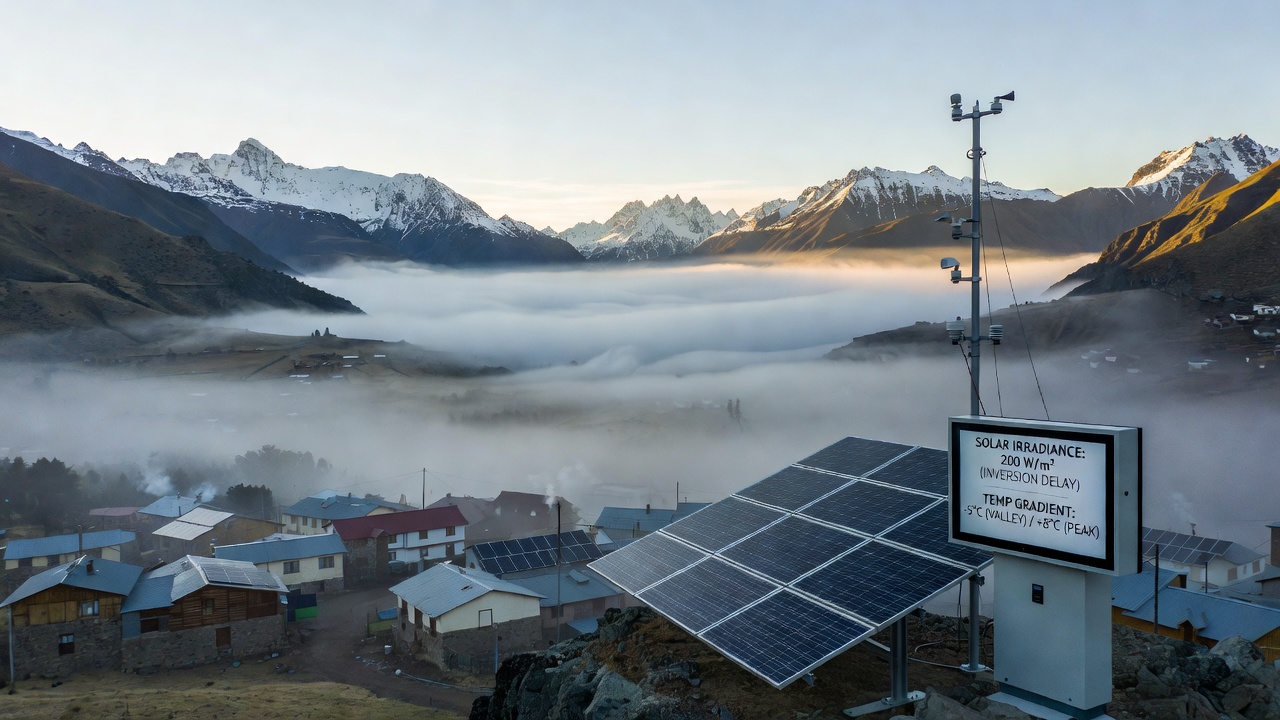
High mountain communities experience temperature inversions when a layer of warm air settles above a pocket of cooler air near the ground, and this reversal of the normal atmospheric profile happens most often during clear nights with light winds. Cold air drains into valleys and basins overnight, while the air aloft remains comparatively warm, so the inversion layer can persist until solar heating breaks it apart after sunrise. Researchers tracking these events across the Rockies and the Alps note that inversions frequently reach their greatest depth between midnight and dawn, then dissipate as surface temperatures climb.
Data collected from sensor networks in the Andes shows inversion strength peaking in autumn months, when longer nights allow more time for radiative cooling at elevation. The same patterns appear in the Himalayas, where valley stations record surface temperatures several degrees lower than ridge-top instruments during the same hours. These temperature differences directly influence local humidity, because the trapped cold air often holds fog or low stratus clouds that scatter incoming sunlight before it reaches photovoltaic arrays.
Daily Shifts in Solar Irradiance
Once an inversion locks in, the daily solar production cycle changes because reduced irradiance reaches panels during the morning ramp-up period. Panels sited on slopes above the inversion layer continue to receive direct beam radiation, yet arrays placed lower in the terrain see diffuse light only until the inversion lifts. Multi-year logs from monitoring stations indicate that production curves flatten between 7 a.m. and 10 a.m. local time on inversion days, shifting the daily peak output later toward midday when mixing restores normal lapse rates.
October 2026 records from high-altitude sites in British Columbia illustrate the same delay, with cumulative morning energy yields running 12 to 18 percent below clear-sky expectations on days when inversion persisted past 9 a.m. Afternoon production often compensates once the inversion erodes, but total daily output still registers lower whenever cloud decks linger within the inversion layer. Observers tracking these events emphasize that the timing of dissipation, rather than inversion depth alone, determines how much the production schedule deviates from seasonal norms.
Panel Temperature and Efficiency Interactions
Temperature inversions also modify the thermal environment around photovoltaic modules. Cooler surface air beneath the inversion keeps cell temperatures lower than they would be under standard lapse-rate conditions, and lower cell temperatures improve conversion efficiency because silicon modules lose roughly 0.4 percent output per degree Celsius above 25 °C. Studies conducted by the National Renewable Energy Laboratory have quantified this efficiency gain during inversion events, showing that the benefit offsets only part of the irradiance loss caused by trapped moisture and haze.
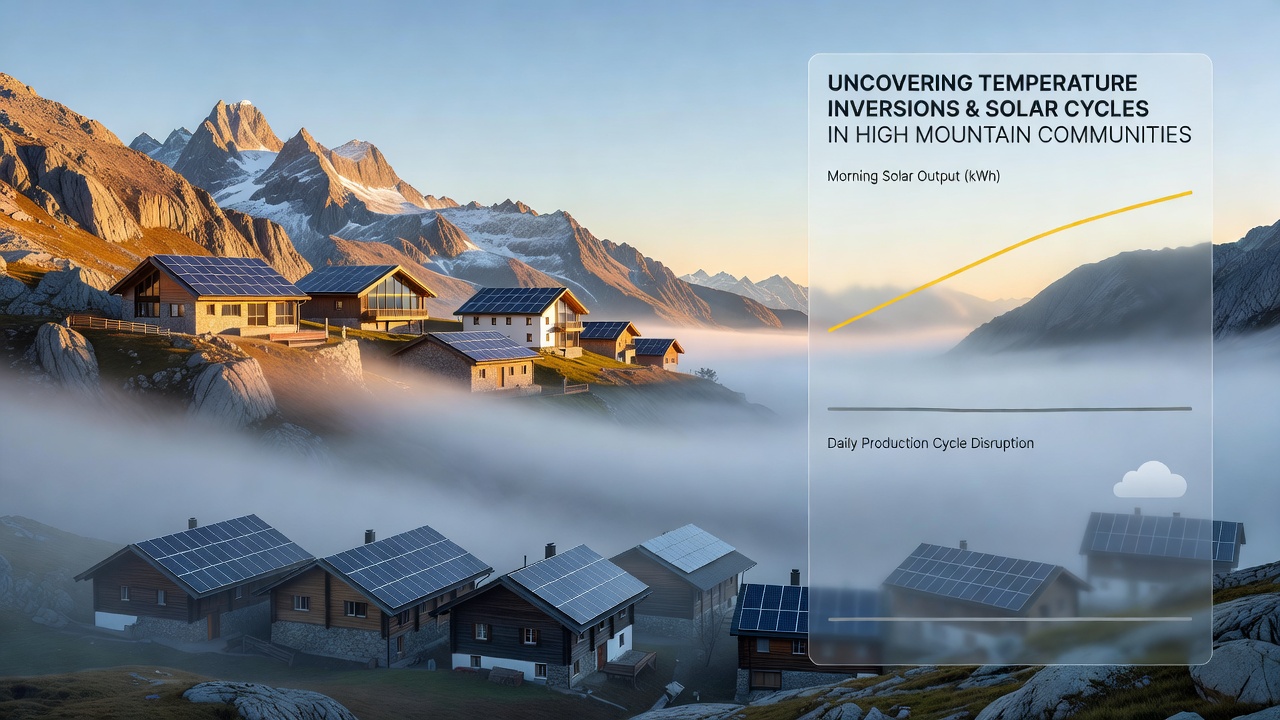
Yet the net result remains negative on most inversion mornings, because the reduction in incoming solar energy outweighs the modest efficiency boost from cooler cells. In the European Alps, similar measurements reported by the European Environment Agency confirm that the irradiance deficit dominates, particularly when relative humidity inside the inversion exceeds 85 percent and scattering intensifies. Those findings align with observations from Australian alpine sites, where inversion-related fog events have been logged for more than a decade.
Community-Level Impacts and Monitoring Efforts
Remote highland settlements that rely on rooftop or small ground-mounted arrays face the most noticeable shifts in daily energy availability. When morning production drops, battery charging windows shorten and households adjust consumption patterns to match the altered supply curve. Sensor networks installed since 2022 in several Andean villages now transmit real-time inversion alerts, allowing operators to anticipate reduced output and prioritize essential loads during the first hours after sunrise.
Long-term datasets reveal that inversion frequency varies with topography and season, yet the effect on production cycles remains consistent across latitudes. Communities in the Canadian Rockies, for example, record 25 to 35 inversion days each autumn, while comparable counts appear in the Southern Alps of New Zealand. These parallel patterns suggest that any future expansion of distributed solar in high mountain regions will require inversion-aware modeling to forecast reliable daily yields.
Conclusion
Temperature inversions reshape solar production cycles in high mountain communities by delaying morning irradiance, trapping moisture that scatters sunlight, and altering the thermal conditions around photovoltaic cells. Sensor records from multiple continents demonstrate that the timing of inversion breakup determines how far daily output curves shift, and the net energy loss persists even when cooler cell temperatures provide a partial efficiency gain. Ongoing monitoring through October 2026 and beyond continues to refine these relationships, supplying the data needed for accurate forecasting in elevated terrain.